Tether recently made headlines due to its jaw-dropping pace of gold acquisition, on the order of one to two tons per week. But even more interesting were the remarks made by Tether CEO Paolo Ardoino, who painted a picture of a multipolar global monetary system where tokenized assets provide a true alternative to the US dollar.
According to Ardoino, Tether now owns some 140 tons of gold—currently worth $24 billion in light of the yellow metal’s spectacular performance in the last year. As the LA Times article explains, Tether has secured a retired Swiss nuclear bunker for its vault. The gigantic stockpile is used directly as reserves for the Tether Gold (XAUT) token, but also as a supplemental reserve for the original Tether USD stablecoin.
Quoting from an interview Ardoino had given to Bloomberg, the article shares his perspective on the role of gold in the global financial system going forward. For example, Ardoino explained that gold is “logically a safer asset than any national currency,” and that “[e]very single central bank in the BRICS countries is buying gold.”
To underscore Ardoino’s claim, consider the following table I constructed in 2022 from
World Gold Council data:
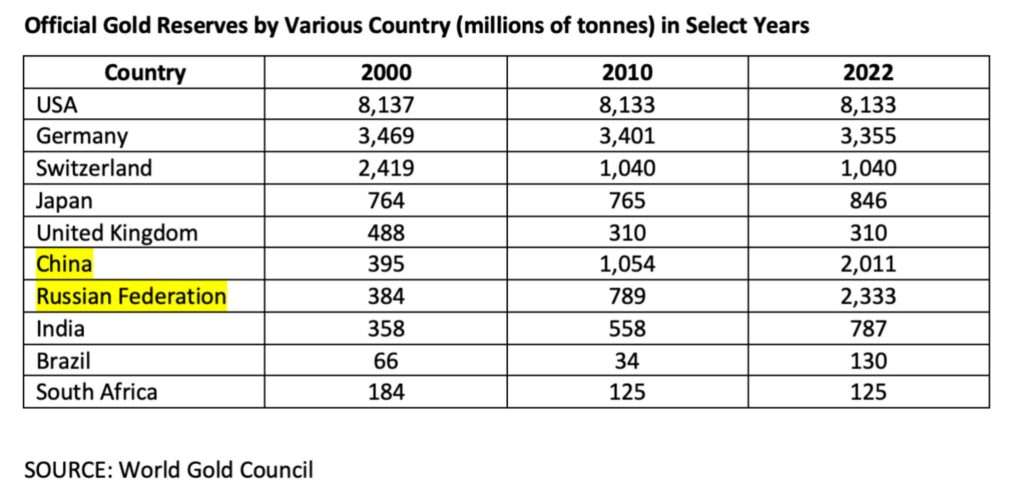
With the exception of South Africa, from 2000 to 2022 the BRICS countries had all engaged in a massive accumulation of gold, while the US and four of its wealthiest allies had (as a group) let their stockpiles dwindle, with only Japan posting an actual (yet still tepid) increase. (As of the most recent 4q 2025 data, China now has 2,306 tonnes, while Russia’s stockpile has slightly declined to 2,327.)
Given that the BRICS nations are building huge gold stockpiles, what are they going to do with them? Ardoino offered a prediction on that score as well:
While XAUT and other gold tokens remain minnows compared with the more-than-$500 billion ETF market, Ardoino predicts that their time will soon come.
“The way I see it is that there are foreign countries that are buying a lot of gold, and we believe that these countries will soon launch tokenized version of gold as a competitive currency to the U.S. dollar,” Ardoino said.
I was intrigued by his analysis, because that’s what I’ve been saying as well. For example, when I appeared on a stablecoin panel at Benzinga’s NYC event in November, I predicted that the rise of stablecoins would initially (over the next five years, say) strengthen the dominance of the USD globally. However, in the longer run, I thought it might actually weaken the dollar. Once major institutions around the world develop secure interfaces to the blockchain—which are necessary to move USD-pegged stablecoins—it would merely be a click of a button to engage a pull-down menu to diversify into stablecoins pegged to an ounce of gold.
For years, when critics warned that the Federal Reserve’s easy money policy, and DC’s reckless deficit spending, would eventually spell the dollar’s demise, the optimists would fire back, “Where else can people go? The yuan? The ruble?” But as Ardoino now agrees, gold-pegged stablecoins will surely play a pivotal role in global finance in the coming decades. Tether and other companies like it are effectively market-based central banks, offering superior products to coercive government analogs.
Dr. Robert P. Murphy is the Chief Economist at infineo, bridging together the dependability of Whole Life insurance policies with the benefits of blockchain-based finance.
Twitter: @infineogroup, @BobMurphyEcon
Linkedin: infineo group, Robert Murphy
Youtube: infineo group
To learn more about infineo, please visit the infineo website