Recently on Twitter/X, Forida Governor Ron DeSantis had an exchange with historian (and my former co-host) Tom Woods, on the topic of World War 2 and whether it ended the Great Depression. Tom originally challenged DeSantis’ claim, and then DeSantis clarified his position. The episode provides a good opportunity for me to spell out some critical points in the alleged economic virtues of war.
Did DeSantis Mean to Endorse Obama?
In response to someone else crediting FDR’s New Deal for tackling the Depression, DeSantis claimed that no, it was the war that did it. In response, Tom Woods explained that this typical Republican position actually concedes the entire economic point to Democrats and their “pump priming” worldview:
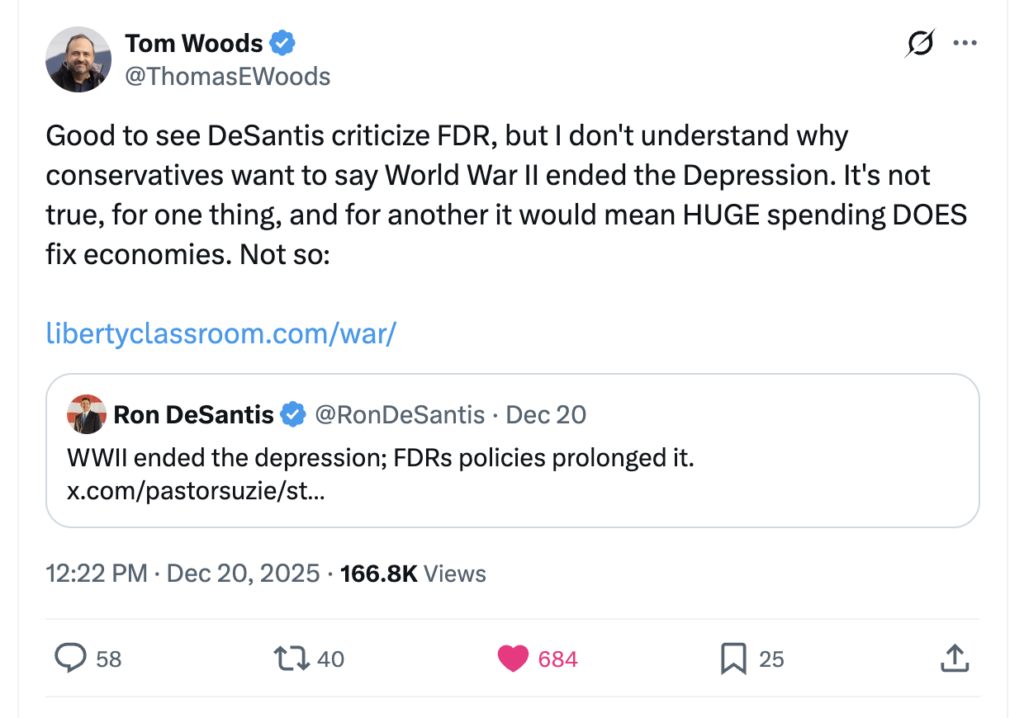
To elaborate on Tom’s point: World War 2 involved massive increases in federal deficit spending. Furthermore, there is nothing intrinsically “productive” or helpful to the US economy that comes from the accumulation of battleships, tanks, bullets, etc. So if the war effort “ended the depression,” it presumably must be coming from the sheer spending itself. And if that’s true, then the Big Government Democrats have been right all along.
DeSantis Clarifies
To his credit, DeSantis saw Tom’s tweet and tried to clarify:
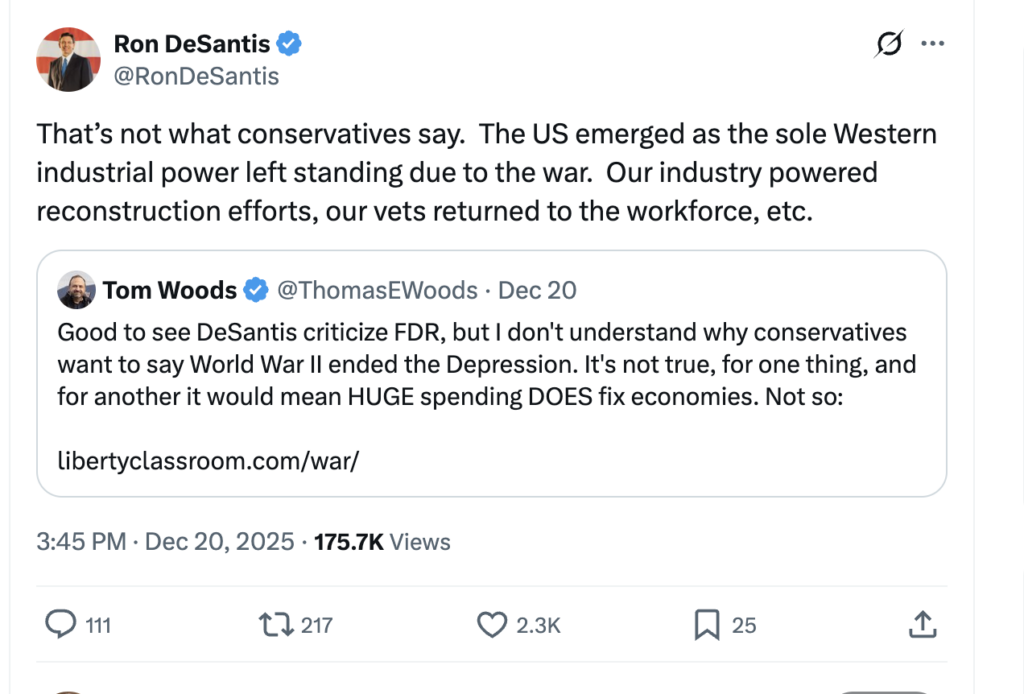
Now to be sure, I’m glad that DeSantis didn’t dig in his heels, and argue that sometimes government deficit spending does fix the economy. Instead, as you can see in the second screenshot, DeSantis clarified that it was the US’ position at the end of the war that was so decisive.
Yet unfortunately for DeSantis, I don’t think this move works either. First of all, the part about the “vets return[ing] to the workforce” doesn’t really make sense, unless you were trying to explain how World War 2 prolonged the Depression. In other words, it doesn’t make sense to argue that the war ended the Depression by letting people return to the private labor force—they were already in the private labor force before Pearl Harbor.
So that leaves the issue of the hollowed-out European industrial capacity. It seems obvious to people that the wartime carnage was a boon to the unscathed US homefront. But why would we think that? In general, isn’t it more advantageous to be surrounded by rich, productive neighbors and colleagues, rather than poor, ill-equipped ones?
To avoid confusion, let me concede that a decimated Europe would be good for certain segments of the US economy. This is true in general, whenever certain producers are taken out of the market. For example, suppose half the dentists suddenly decided to give up their profession and retire immediately. How would that affect the rest of society? It would presumably be beneficial for the remaining dentists, as they would now see a huge demand for their services and could consequently raise their prices.
But probably the non-dentists would in general be hurt by this wave of sudden retirement, because now they would have to scramble to find a new dentist and/or would have to pay more for fewer available appointments.
A similar analysis applies to the global economy as of 1946. The need to rebuild European/Asian industry would be a boon to those segments of the US economy that specialized in the production and export of such products. But the impoverishment of US trading partners—including not just the physical destruction but also the slaughter of tens of millions of productive workers—would surely make the average American not working in those particular sectors, poorer than he or she would otherwise be.
For a specific example, consider American farmers, who could export large amounts of wheat and corn in the late 1940s to the rest of the world. Would those farmers want their customers to have the ability to make intricate manufactured goods to offer in exchange for American wheat? Or would it be better for the farmers if their potential customers lacked the facilities to produce sophisticated products?
A moment’s reflection reveals that as a general rule, Americans are made richer by the wealth and productivity of foreigners. To put things differently, the reason 25% of American workers couldn’t find a job in 1932, was not that Europe had too many factories, or that Japan had too many young men who were alive. (These were things that would later be “cured” by the war.) So when we’re trying to understand what “fixed” the broken US economy of the 1930s, it doesn’t work to merely cite the facts as DeSantis did.
Conclusion
Although a superficial analysis might suggest that World War 2 was “good for the economy,” at least for America, deeper reflection reveals that war is a parasite on production. For strategic and political reasons, it may be deemed necessary for a country to go to war. But economically, the war is costly; its expense (in forfeited civilian output as well as human casualties) may be justified by the apparent benefits, but there really are costs involved.
Florida Governor Ron DeSantis pivoted from the crudest fallacy and offered a more sophisticated explanation for why World War 2 ended the Depression, but even his clarification ultimately failed. The US in general is made richer with a strong and productive Europe and Asia. Foreign trading partners offer more opportunity for US workers to produce and export, when those trading partners are equipped with factories and filled with productive citizens.
Dr. Robert P. Murphy is the Chief Economist at infineo, bridging together the dependability of Whole Life insurance policies with the benefits of blockchain-based finance.
Twitter: @infineogroup, @BobMurphyEcon
Linkedin: infineo group, Robert Murphy
Youtube: infineo group
To learn more about infineo, please visit the infineo website
Lorem ipsum dolor sit amet, consectetur adipiscing elit. Ut elit tellus, luctus nec ullamcorper mattis, pulvinar dapibus leo.