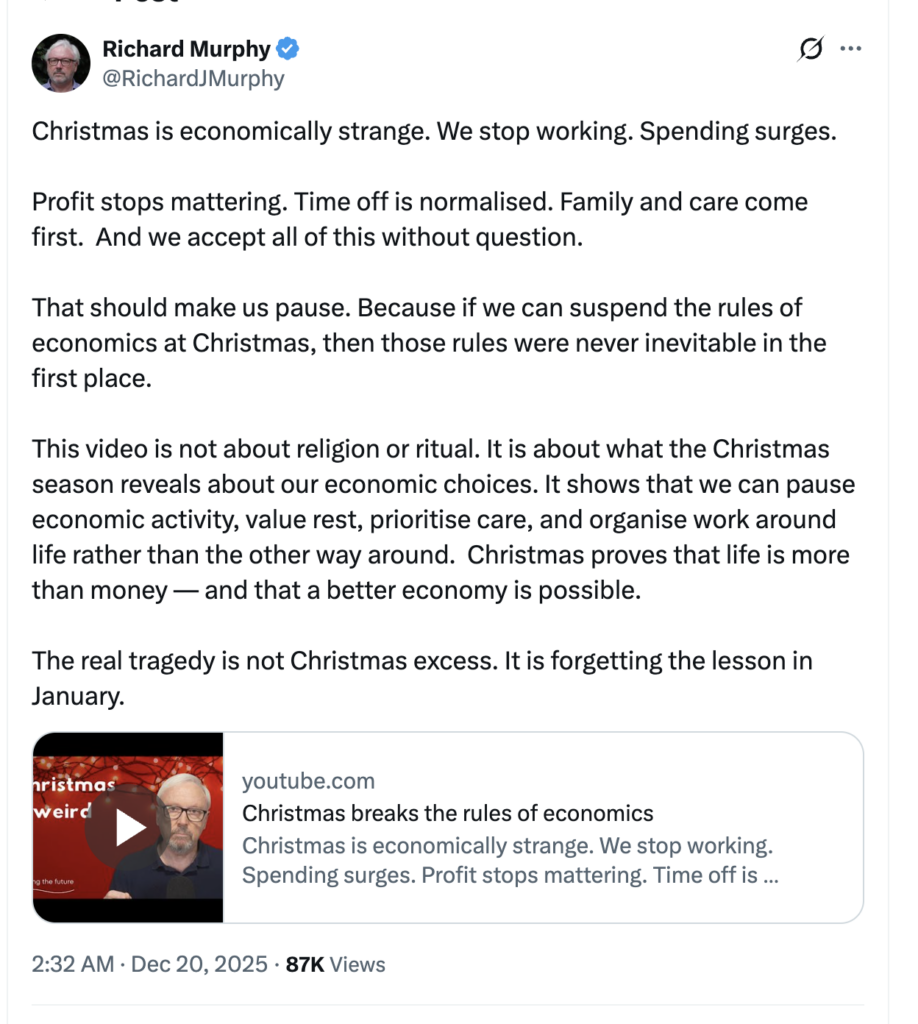
Just before the holiday retired Accounting Professor and economic commentator Richard Murphy (no relation) posted a YouTube video/X post arguing that the normal rules of economics are suspended every year around Christmas. He claimed that this shows the “rules” aren’t really rules at all, and lamented that businesses and governments don’t adopt the Christmas spirit the entire year. In today’s blog post, I’ll walk through the elementary problems with Murphy’s case.
Richard Murphy’s Case for Christmas
This screenshot provides a good summary of Murphy’s position, though interested readers can click and watch his 6-minute YouTube video making a more detailed case:
Where I Agree
I am largely critical of Murphy’s sentiments, but let me start by acknowledging where we agree: It is certainly the case that holiday cheer and “goodwill toward men” characteristic of the Christmas season, are attitudes that we should carry throughout the year. And yes, the holidays remind us that our family and friends are more important than our fiscal position.
But Murphy went far beyond such truisms. No, he is arguing that because people “stop working” while “spending surges” at Christmas, that the usual rules of economics must not be true. And it is this element of his analysis that I will now challenge.
Christmas Gifts Don’t Come From Santa’s Workshop
The reason most people can take vacation time off from work in late December, and still be able to buy gifts for their loved ones, is that people were productive enough earlier in the year to carry things forward through the holiday break. Contrary to what many children believe, Christmas gifts aren’t actually assembled in the North Pole.
There is nothing peculiar about Christmas in this respect. By the same token, most workers “stop working” while “spending surges” on the weekend. Did I just prove that it’s a mere social convention that people think they “have to work” Monday through Friday? Could we just agree that we can have, say, a 5-day weekend instead—because after all, profits don’t matter, right?
We can push it even further. Even during a workday, most workers only clock in 8 or 9 hours. The majority of the day, they aren’t working, and in fact that’s when they spend their money—outside of work. So did I just prove that working and spending have nothing to do with each other?
Holidays for Adults, and Schooling for Kids, Are Luxuries
There is a distressing tendency among many progressive reformers to view achievements in our standard of living as due to mere social agitation. For example, I know that many labor activists honestly believe that were it not for unions and progressive legislation, British and American children would still be working in mines or factories, and adults would work 6 days a week, 52 weeks per year.
But this is nonsense. In poorer societies, the children need to work in order to stave off starvation for the family. This was true of all countries in the Middle Ages, and it’s still true in the underdeveloped regions of the world today. It was only the huge advances in the productivity of adult labor wrought by the Industrial Revolution that made it possible for children to engage in play and school, rather than getting a job.
Likewise, as the total amount of output per hour of adult labor went up, it became feasible for the average worker to rest not only on the Sabbath, but on an extra day as well. Although labor unions call themselves “the folks who brought you the weekend,” in reality it was (relatively unfettered) capitalism that did the trick.
Conclusion
It is important for people to understand the basic lessons of economic history. For most of world history, the average human eked out a subsistence level of existence. It was only with the institutional and legal developments that ushered in the Industrial Revolution that allowed for an explosion in per capita productivity and hence living standards. Social reformers who try to achieve “gains” faster than productivity will allow, are going to kill the proverbial goose that laid the golden eggs.
Dr. Robert P. Murphy is the Chief Economist at infineo, bridging together the dependability of Whole Life insurance policies with the benefits of blockchain-based finance.
Twitter: @infineogroup, @BobMurphyEcon
Linkedin: infineo group, Robert Murphy
Youtube: infineo group
To learn more about infineo, please visit the infineo website