Partly due to dueling statistics I encountered on a recent X Space conversation, I decided to look at the historical returns of gold versus Bitcoin. (I also threw in the S&P 500 for completeness.) Although gold has had a tremendous run in the last year, whereas Bitcoin crashed, we can see that Bitcoin has still been a higher-returning asset for most time stretches. Indeed, if we start at the beginning of each calendar year and look at the compound average return through February 9 of 2026, Bitcoin outperforms in every year up through 2020, and it also outperforms if you happened to get in, in early 2023. Moreover, the recent Bitcoin crash, although large, is smaller than earlier crashes (in percentage terms). In sum, so long as you have a strong stomach and can stay in for several years, Bitcoin still looks like a durable asset—at least if we take history as our guide.
The Numbers
In the following table, I’ve documented the level of gold, Bitcoin, and the S&P 500 as of early January from 2011 through 2026, and then I also include the values for February 9, 2026 to capture the crash in Bitcoin. Subsequent columns then rank the assets according to their performance over various time horizons:
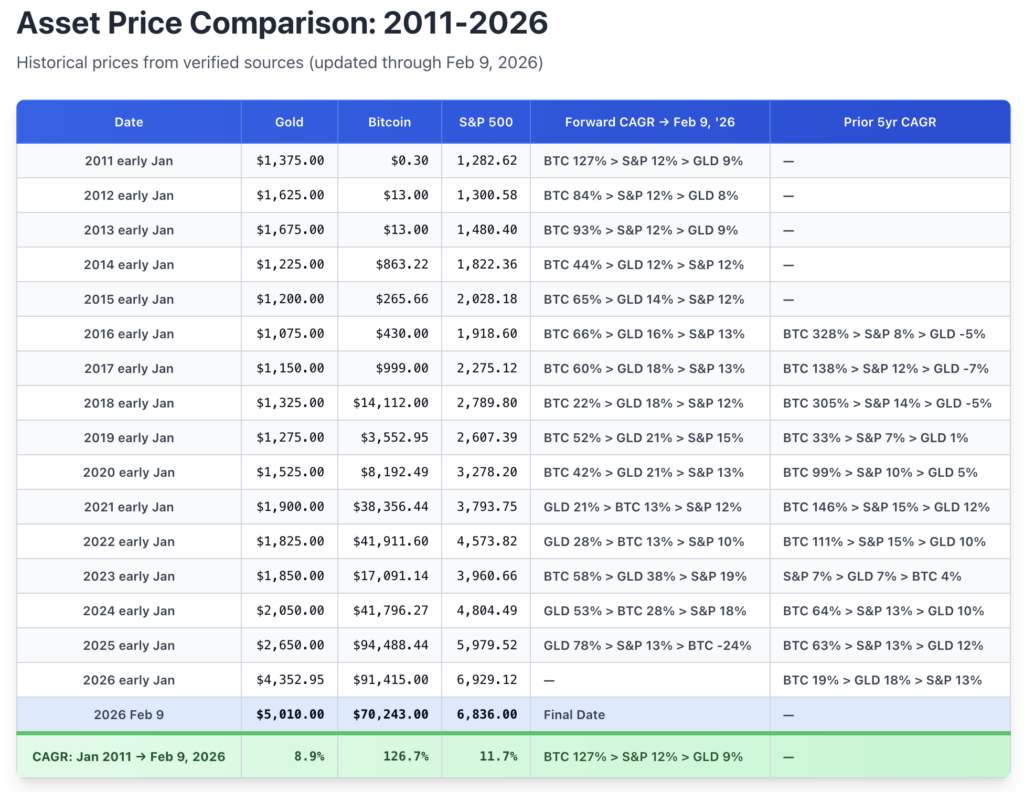
As indicated in the final, green row, the performance over the full 15 years isn’t even close: Bitcoin had an annualized return of some 127% (meaning your investment would more than double, on average, every year for 15 years in a row), whereas for gold it was 8.9% and the stock market was 11.7%.
If we do a similar calculation at each of the calendar years going forward, we see that Bitcoin was once again the best asset to be in, from 2011 through 2020. In 2021 and 2022, it would have been better to get into gold (because its annualized returns were 21% and 28% respectively, compared to Bitcoin’s 13% for both years), but then in the start of 2023 once again it would have been better to get into Bitcoin. (This is because Bitcoin crashed during 2022, meaning you could get in at $17,000 in early 2023.) Then once again, in the start of 2024 and 2025, it would have been better to get into gold rather than Bitcoin.
From this analysis, one might be tempted to say, “So long as your investment horizon had been longer than 5 years, Bitcoin was better than gold.” Yet even that gives too much credit to gold (or rather, not enough to Bitcoin). I illustrate my point in the final column. There, for each start of the calendar year, we look backwards over the prior 5 years, to rank the assets by their CAGR in that stretch. We see that with this metric, Bitcoin beats gold for every single year—including the start of 2026—and the only time you would have preferred to be in gold, is if you start the five-year lookback in February of 2026.
Finally, as one last comment on the above table, consider what the total annualized growth rate on Bitcoin was, as of each potential starting year. (So we’re looking at the second-last column from the right.) In the early years, Bitcoin was through the roof. But notice that the lowest it gets is in 2021 and 2022, where the compound annualized growth (through February 2026) is 13 percent. It’s only if you got in, in early 2025, that you would be down (with the specific choices we have in this table).
Put differently, so long as you have been in Bitcoin for at least two years, then the lowest your annualized return would have been, is 13 percent. Scanning that second last column, you can see that that’s what the stock market does in general. And in general, that’s much better than what gold did, during the whole period.
Conclusion
As of early February 2026, looking back over the last fifteen years, so long as you held it for at least two years, Bitcoin’s annualized return ranged from 13 percent to 127 percent. In contrast, if you were in gold and had held it at least two years, your annualized returns ranged from 8 percent to 53 percent. And if instead you had been in the stock market, your annualized returns ranged from 10 percent to 19 percent.
As always, I stress that I’m not here giving investment advice. But these historical figures show that the people claiming the latest crash means “Bitcoin is broken” are focusing on a very shortsighted read of history.
Dr. Robert P. Murphy is the Chief Economist at infineo, bridging together the dependability of Whole Life insurance policies with the benefits of blockchain-based finance.
Twitter: @infineogroup, @BobMurphyEcon
Linkedin: infineo group, Robert Murphy
Youtube: infineo group
To learn more about infineo, please visit the infineo website