In a recent InFi episode, I interviewed Dan McCarthy on the proposed California ballot initiative (for which supporters are still acquiring signatures) that would levy a one-time 5% wealth tax on any billionaires in the state. In the conversation, McCarthy and I alluded to the proposal’s impact on wealthy individuals relocating, but in the present article I’ll give some specific numbers.
Anecdotally, there are already several high-profile tech billionaires who have distanced their personal residences and/or businesses from California. The list includes Mark Zuckerberg, Google’s Larry Page and Sergey Brin, Peter Thiel, and Elon Musk.
But the migratory pattern is not confined to a few high-net worth individuals. In the following table, we display the top two and bottom two states in terms of total net domestic migration between July 2020 and July 2024:
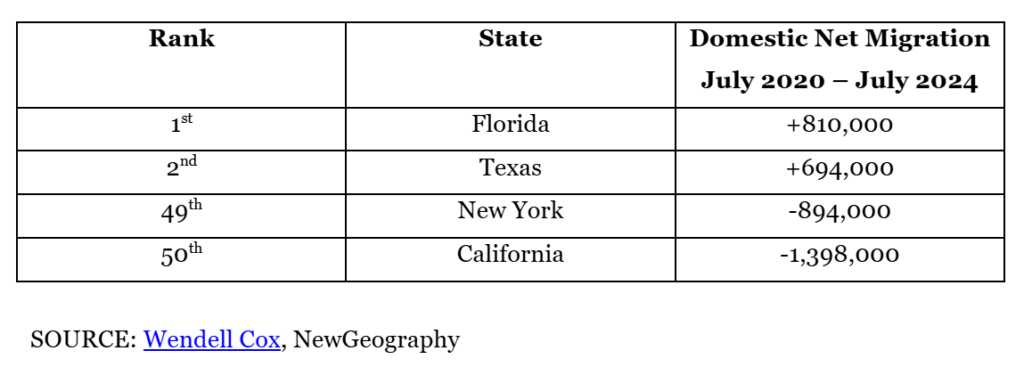
To be clear, the above table excludes the impact of foreign immigration into the country (which supplements California, especially). But if we instead look at people who are already inside the United States, the internal movement among the states exhibits the above pattern.
In addition, to show that the above numbers aren’t merely a reflection of the size of the states’ populations, we can present the following map which is color-coded according to the percentage change in a region’s population:
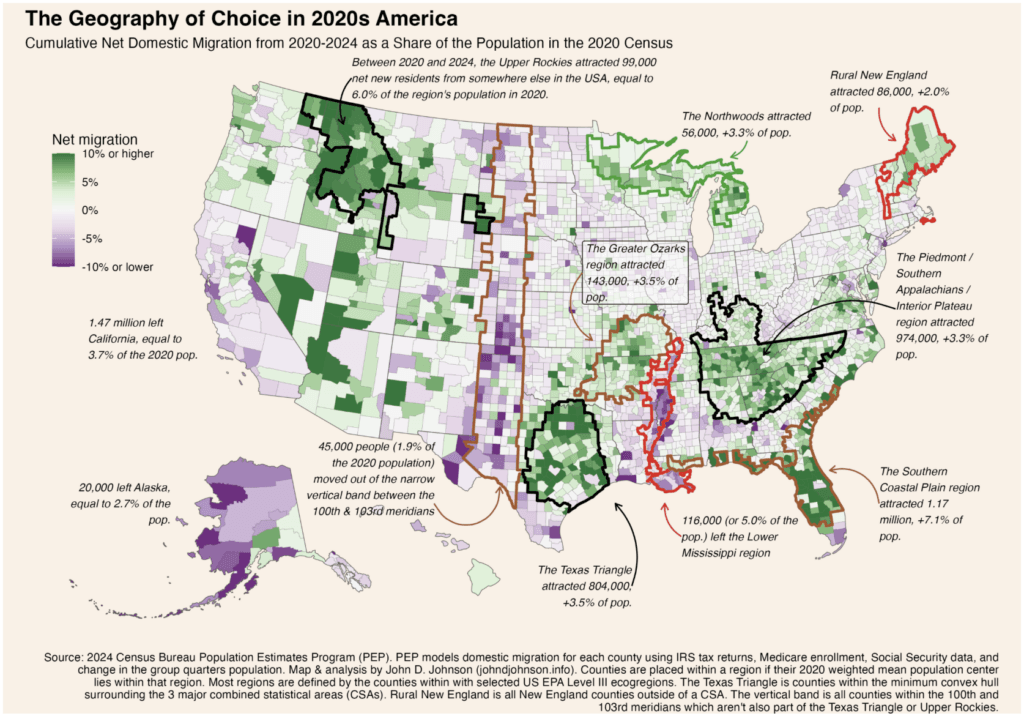
The map indicates that California has some dark purple regions, showing large percentage drops in population, whereas Texas and Florida (especially) are packed with dark green regions.
Besides California’s proposed wealth tax, there is also the different Covid-era policies. Furthermore, the recent election of Mamdani as New York City mayor no doubt will accelerate the departure of wealthy individuals and businesses from the Empire State. Another major difference is the state-level personal income tax rate. The highest in the nation is California, at 13.3%, while New York comes in third (after Hawaii) at 10.9%. In contrast, neither Florida nor Texas has a personal income tax at all.
As a final point, let me run through the arithmetic to show the impact on the margin from such tax rate differences. If we factor in the federal top rate of 37%, then for income that is subject to both (i.e. assuming there is not an applicable SALT deduction), the combined top marginal tax rate in California on the highest incomes would be 50.3%. In contrast, in Texas or Florida it would only be 37%. So for an addition $1,000 in pre-tax income generated, someone in California would keep $497, whereas in Florida or Texas would keep $630. That’s a 27% increase in the after-tax income retained, i.e. double the apparent 13.3 percentage point difference just looking at the state rates.
Conclusion
There are many factors that go into the decision of where to live and/or start a business. Tax policy is only one consideration, but it is more important than many people realize. As McCarthy explained in our discussion, this is probably why even Gavin Newsom—no foe of Big Government—was concerned about California implemented a “billionaire tax” in isolation. If billionaires can avoid the tax just by relocating to a nearby state, then many will do just that. That will reduce tax receipts and jobs in California, which doesn’t do anything to help pay for health care.
Dr. Robert P. Murphy is the Chief Economist at infineo, bridging together the dependability of Whole Life insurance policies with the benefits of blockchain-based finance.
Twitter: @infineogroup, @BobMurphyEcon
Linkedin: infineo group, Robert Murphy
Youtube: infineo group
To learn more about infineo, please visit the infineo website