Senator Bernie Sanders recently posted a provocative tweet on taxing robots, in response to worries that big corporations would use them to replace their human workers. His short statement touches on a host of interesting economic topics, which I will unpack in the present blog post.
Bernie versus the Robots
Here’s the actual tweet from December 29:
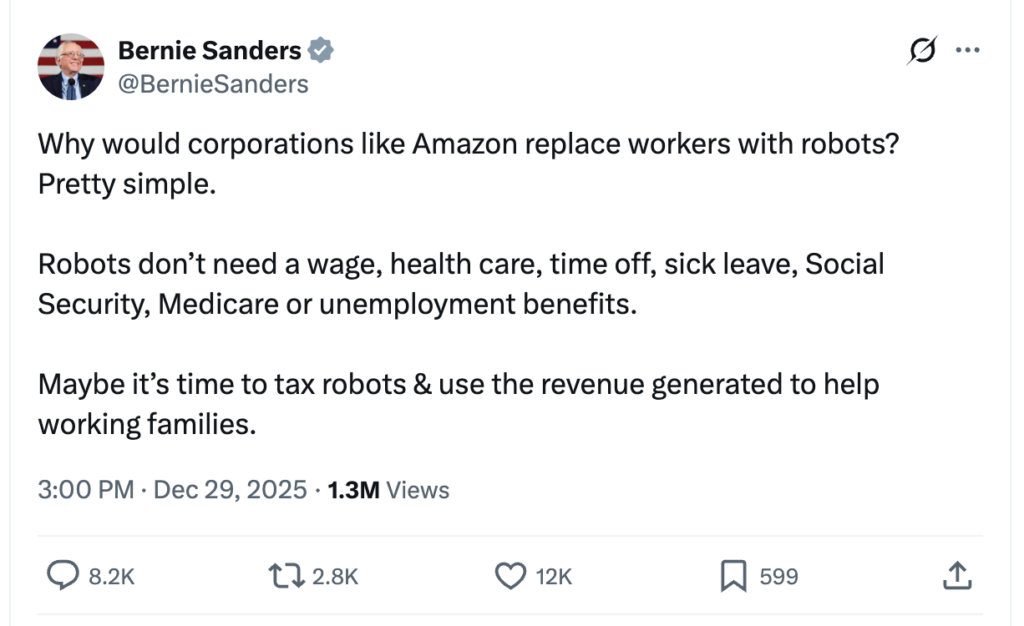
Incidentally, Sanders is presumably responding to reports like this one from the New York Times, which said back in October that Amazon had internal plans to avoid hiring some 600,000 human workers through 2033, by relying on more automation in its operations.
Sanders knows enough economics to understand that if there are various costs associated with hiring humans that do not apply to robot “employment,” then businesses will understandably pivot toward the cheaper source of labor services. But rather than conclude, “Hmm, maybe my colleagues and I should stop loading up businesses with mandates that make human labor more expensive,” Sanders goes the other way and wants to make hiring robots similarly unattractive.
What Would Be the Economically “Correct” Way to Tax Robot Labor?
But let’s assume for the sake of argument that instead of lightening the tax and regulatory burden on human employment, instead we try to apply existing tax law to the use of robot workers. At least in terms of economic theory—and I’m happy for tax accountants to tell me if pure theory is a poor guide in this scenario—here’s how I think we would proceed:
First, to keep things tidy, let’s assume there is a separate manufacturer that buys the raw materials and mass-produces robots. Then individual investors buy the robots for lump sums of cash, and then rent out the robots to companies like Amazon, GE, Ford, etc.
From the point of view of Amazon, GE, Ford, etc., they would be paying an hourly (or annual, whatever) rental payment for the flow of services provided by the robots. This would economically be equivalent to paying similar human workers wages (or salaries) for their labor services. From the perspective of Amazon, GE, Ford, etc., the payments to the robots (or their legal owners) would be a deductible business expense. There would be no reason for these users of robot “labor” to pay an extra tax on top of their payment.
Now it might seem that the rental payments made to the owners of the robots should be taxed in the same fashion as labor income. For example, suppose a human worker at a Ford assembly line gets paid $25/hour. He stands nearby a robot who performs similar tasks. The owner of the robot can actually charge (say) $35/hour for the same mechanical work, because there are all sorts of other expenses that Ford incurs on behalf of the human employee. (Again, for simplicity, let’s assume the robot has no maintenance expenses, it runs on solar power, etc.)
One might suppose that “taxing robots” in this scenario would mean applying the income tax to the $35/hour “wages” of the robot, in the same way that the income tax is applied to the $25/hour wages of the human worker. But we can imagine the tax attorney for the owner of the robot to argue against this, for the following reasons:
The Tax Treatment of Robot “Income”
When the owner originally bought the robot, its purchase price already capitalized the future rental income it would earn over its lifetime. For example, to keep things simple, suppose that the robot is expected to provide 10 years of excellent service, after which it breaks down and must be thrown out. But during its lifetime, it can be rented out to the Ford Motor Co. to work on its assembly line. To further keep things simple, suppose Ford pays a flat $70,000 for each year’s service upfront. I.e. there’s a $70,000 payment to the robot’s owner at the start of period 1, another $70,000 payment at the start of period 2, and so on for ten total periods.
In an idealized market where each factor of production receives the (discounted) marginal value product, the sale price of the robot should equal the capitalized present value of its ten future bursts of cash payments. If we assume a 10% discount rate, the robot’s annual $70,000 rental payments can be decomposed into a return of principal and an interest component, as shown in the following table:
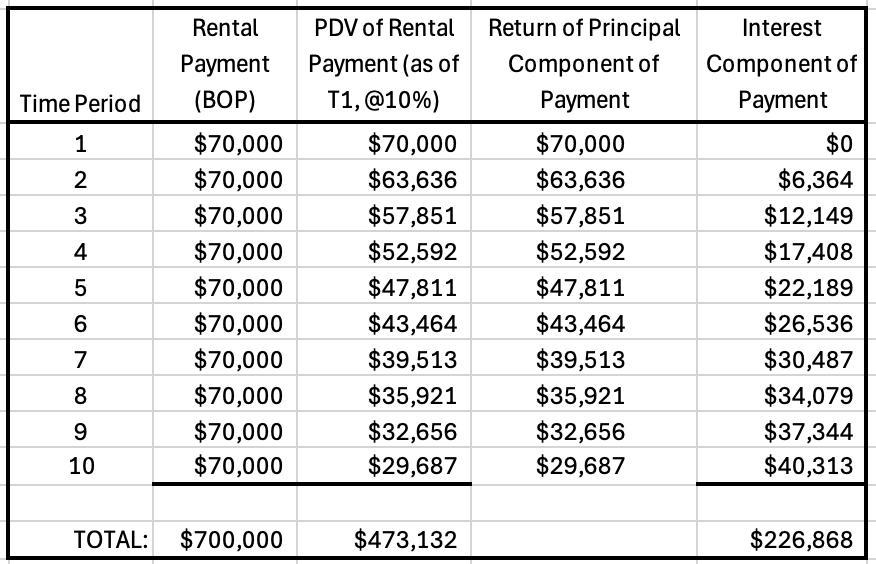
As the table indicates, the present discounted value of the robot’s expected flow of cash payments is $473,132. In a frictionless market, that’s what the owner would have to pay the manufacturer to obtain the brand new robot.
Given this framework, the tax attorney could argue that the first payment of $70,000 from Ford Motor Co. to the robot’s owner shouldn’t be taxed at all. This isn’t genuine income. Instead, it should be accounted as a partial return of principal on the original investment of $473,132. Because we assume Ford pays this amount on Day 1 of employment, this $70,000 of the original investment was only tied up for a short delay, while moving the robot from its own assembly line over to Ford’s. From the robot owner’s viewpoint, he handed over $473,132 but got paid back $70,000 a few hours later—so clearly he couldn’t have earned (much) interest on his investment, and therefore the $70,000 should be construed as a return of principal.
For the second payment of $70,000 from Ford Motor Co. (which the owner receives 12 months after hiring out the robot), the attorney could argue that $63,636 of it was a return of principal, while the remaining $6,364 was a 10 percent interest return on the invested $63,636 (which was tied up for a year). Thus, the owner of the robot would have to pay income tax on the interest income of $6,364.
We’ll do one more: For the third payment of $70,000, only $57,851 would be construed as a return of principal, while the remaining $12,149 would be the interest income—rolling over for 24 months—on that initial outlay. (Note that $57,851 x 1.1 x 1.1 = $70,000.) So in that year, the robot owner would pay income tax on the interest income of $12,149.
Thus the tax attorney would conclude that there’s nothing about the robot’s “income” going on here. Instead, the flows of $70,000 payments from Ford Motor Co. to the robot’s owner should be treated in the same way as the repayment on an amortized loan. The robot’s productivity would affect the size of the rental payments, but a more productive robot would command a higher lump-sum purchase price on the front end. The owner of the robot wouldn’t receive a particular boon from relying on “robot labor” instead of human labor. He would still be earning the same 10 percent return on his robot investment as he would earn in other investments of comparable risk.
What About the Robot Manufacturers?
Thus we see that Bernie doesn’t necessarily have deep pockets to tap when it comes to the companies using the robots or even the companies/individuals who own and rent out the robots.
However, we still have to consider the robot manufacturers. If one or more companies have discovered “secret formulas” (which could consist of hardware designs, AI training regimens, etc.) that allow them to transform raw materials (and labor, whether sourced from human or robot) of a certain market value, say $200,000, into robots selling for $473,132, then there is a mark-up of $273,132 on every unit sold. This is where the “surplus” of the robot output is concentrated in terms of the financial valuation.
Yet even here, at least in terms of economic theory (which is not necessarily how it would be treated tax-wise in the real world), the mark-up per unit robot sold would already be capitalized upfront in the market value of the firm(s) that had access to secret formula(s) for robot production. The first time a team at such a firm stumbled on a valuable secret, the share price of that firm’s stock would have jumped to reflect a one-time (as yet unrealized) capital gain to all of the shareholders in the robot manufacturing company.
Think of the Children!
I believe I have accurately laid out the manner in which a robot’s expected future productivity (over and above its operating expenses on a daily basis) would be capitalized backward in time to the robot’s “birth” off of its own assembly line. The increment in market value of the components going into the creation of the robot—versus the market value of the now-assembled robot rolling off of the line—would be capitalized into the stock price of the manufacturing company. During its lifetime, the periodic rental payments received from the robot’s “employer” (i.e. Ford Motor Co.) would reflect either a return of principal or an interest return on the financial capital originally inhering in the brand-new robot.
What implications does this have for human workers? If we were to treat them similarly, we would say that upon birth, a human is the recipient of a one-time unrealized capital gain, reflecting the present discounted value of his or her future wage income (or equivalent). Then what we now call wages (or salaries) would be an implicit interest return on this “human capital” and should only be taxed at the same rate as other forms of interest income.
Conclusion
Bernie Sanders is right to suspect that workers do not receive the same tax treatment as owners of capital. But rather than his solution of tightening the screws on capital, it would make more sense to expand the rights of workers to classify their income on the same terms as the capitalists.
Dr. Robert P. Murphy is the Chief Economist at infineo, bridging together the dependability of Whole Life insurance policies with the benefits of blockchain-based finance.
Twitter: @infineogroup, @BobMurphyEcon
Linkedin: infineo group, Robert Murphy
Youtube: infineo group
To learn more about infineo, please visit the infineo website