In my previous post, I laid out the portion of my macro outlook pertaining to the yield curve and the Fed’s new posture. In this post, I’ll focus on the labor market, with an emphasis on the impact of AI.
Headline Unemployment versus Labor Participation Rates
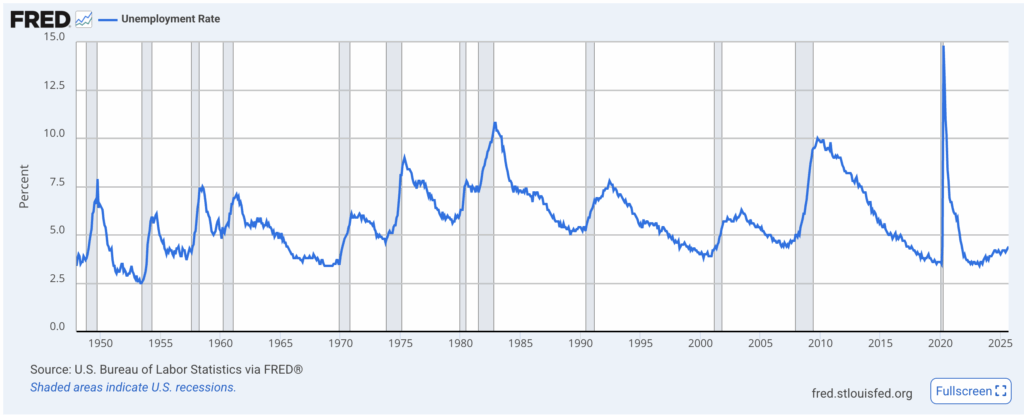
At face value, the official unemployment rate is still at relatively low levels, looking back over decades:
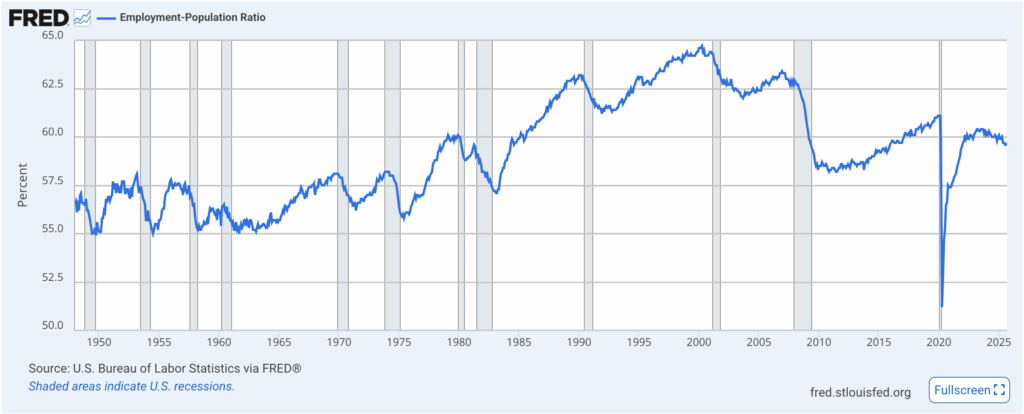
However, ever since the financial crisis of 2008, analysts have pointed out that the official unemployment rate is ignoring the workers who have simply left the work force (and hence no longer count as “unemployed”). This trend was exacerbated by the Covid/lockdown slump, which we can see by charting the percentage of the total population that is employed:
Yet even this graph is potentially misleading, because the US population has aged since 2000. In order to disentangle the demographics from the economics, in the following chart I show the labor force participation rate among four different age brackets:
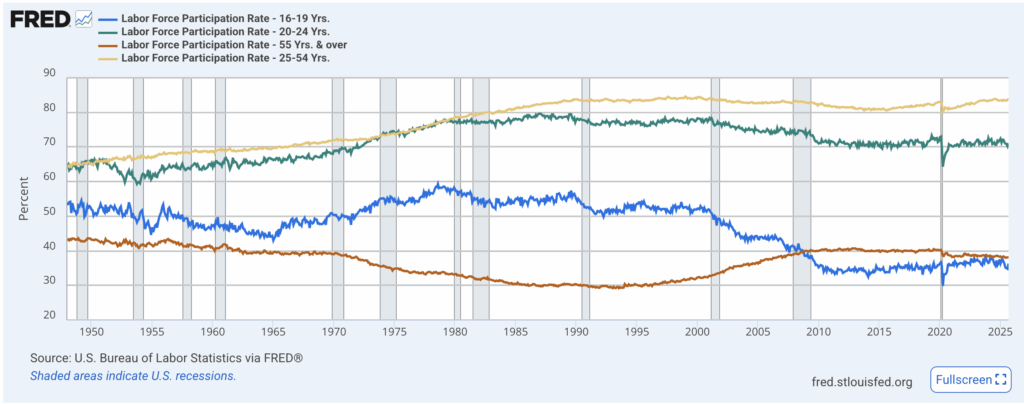
As this final chart shows, the fraction of the prime-age workforce that is still actively in the job market has remained high; it is currently at the same level as in the 1990s. And among older workers, participation in the labor force is actually much higher now than in the mid-1990s.
On the other end of the spectrum, we see that labor force participation has plummeted among teenagers, and has fallen significantly among 20-24 year olds.
However, these trends among youth employment started after the dot-com crash and the recession in the early 2000s, and were solidified after the 2008 crisis. At least according to this metric, it’s simply not true that young people in general are being hurt by AI, because the problems (if we consider them problems) occurred years before the release of ChatGPT 4. (Although I haven’t shown it above, the official unemployment rate for 16 – 24 year olds is relatively low by historical standards, just like the overall rate.)
Anecdotal Evidence
There are recent news articles indicating that recent college grads are finding it more difficult to land their first “real job” than in previous business cycles. And I have also seen hiring data that suggest certain types of firms—such as those in information services—are slowing their hiring for entry-level positions, whereas they are continuing to fill mid-level slots. These trends generally line up with the introduction of advanced LLMs.
However, at this point it’s still too early to draw any firm conclusions, because the advanced LLMs came to market when the Fed also began raising rates rapidly (in light of the Covid/lockdown price inflation). It’s not shocking that tech firms—which often thrive on cheap money—would become more conservative than other firms when the Fed tightens.
As time passes and we get more data, we will be in a position to draw firmer conclusions. Right now I would say the data are consistent with the idea that AI is making it harder for young people to get their first job, but we don’t have enough evidence yet to understand the scope of the impact.
A Possible Employment/GDP Disconnect for “Recession” Definition
As a final thought, let me mention that we may see a difficulty emerge when asking, “Is the US in a recession?” Over the next few years, it is possible that we will see a sharp rise in the unemployment rate, particularly among younger workers applying for technical jobs (as opposed to blue collar employment). At the same time, as more firms incorporate LLMs into their business model, we may see real GDP rising at impressive rates.
In other words, because of the efficiencies of AI, a smaller portion of the human workforce might be able to make more stuff (and services). We could be in a position where a sizable fraction of the work force can’t get a job, but total output keeps breaking records. In this environment, it would be difficult to classify whether the economy is in recession, because the normal rule of thumb—namely, two consecutive quarters of declining real GDP—might seem inadequate if it fails to flash while the official unemployment rate jumps to (say) 8 percent.
Conclusion
There are pockets of evidence that AI, while boosting the productivity of employed workers, is making it harder for young people to get their first real job. We will know more as 2026 unfolds. If the critics are right, we could see a disconnect where some Americans are stuck in an economic rut while the overall economy enjoys rapid growth. Besides one’s personal feelings on such matters, this type of dynamic could lead to political unrest that every business leader will have to monitor.
Dr. Robert P. Murphy is the Chief Economist at infineo, bridging together the dependability of Whole Life insurance policies with the benefits of blockchain-based finance.
Twitter: @infineogroup, @BobMurphyEcon
Linkedin: infineo group, Robert Murphy
Youtube: infineo group
To learn more about infineo, please visit the infineo website